Revival: Right on Time?
In Spring 2024, well ahead of any talk of a ‘Quiet Revival’ in the UK, I was asked to introduce a group of visiting American students to the history of the Christian faith in Oxford. As I reviewed that history, I was reminded that there have been successive waves of church renewal over the centuries. More than, there is a clear pattern of revival of the Christian faith within every 300 years, and that leads us to expect another revival right about now!
Here are my slides.

A Theory
Writing in the Journal for the Scientific Study of Religion in 2002, sociologists Roger Finke and Patricia Wittberg described the historic pattern of revivals and reform within the Roman Catholic Church. After surveying the last 1500 years, they wrote: “Religious [movements] tend to follow a path of gestation, consolidation, expansion, stabilization, decline, and extinction, with the entire cycle lasting usually somewhere between 250 and 350 years,” after which another new movement will arise.
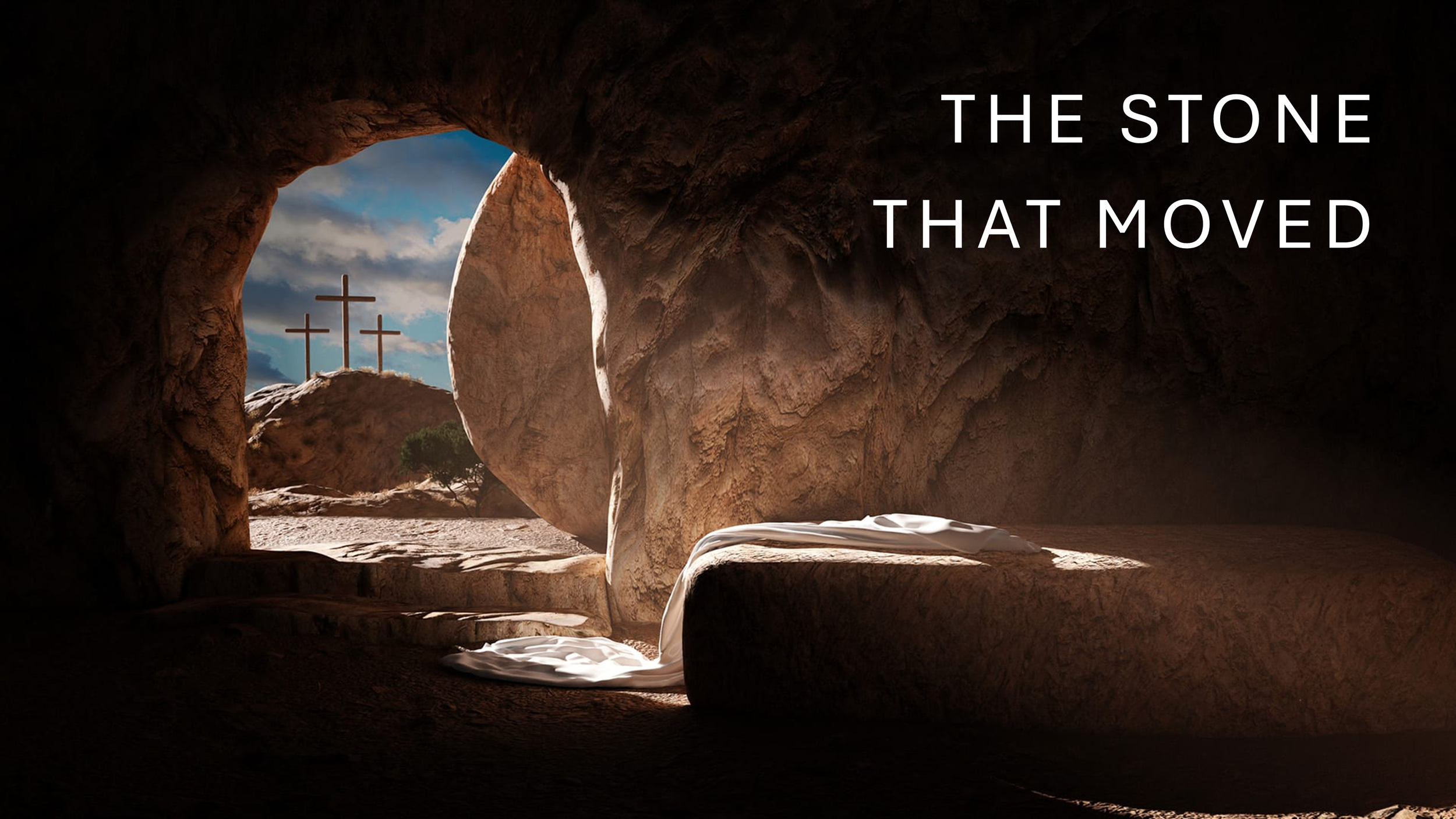
30 A.D.
It is intriguing to note that a similar ‘wavelength’ of revival in religion can be seen in the history of the church in Oxford, beginning at a time roughly 300 years after the first Easter Day - then through Roman Britain, medieval and early modern Catholic periods, and the Protestant Reformation - and leading us to expect something big to happen in our own generation.

300 A.D.
The oldest evidence of the Christian church in the Thames Valley is a lead font found near Caversham, bearing the chi-rho symbol. We know very little about this season of church life: only that the good news about Jesus had somehow spread all the way from Jerusalem to this region… until Romano-British culture was undone by repeated pagan Saxon invasions.
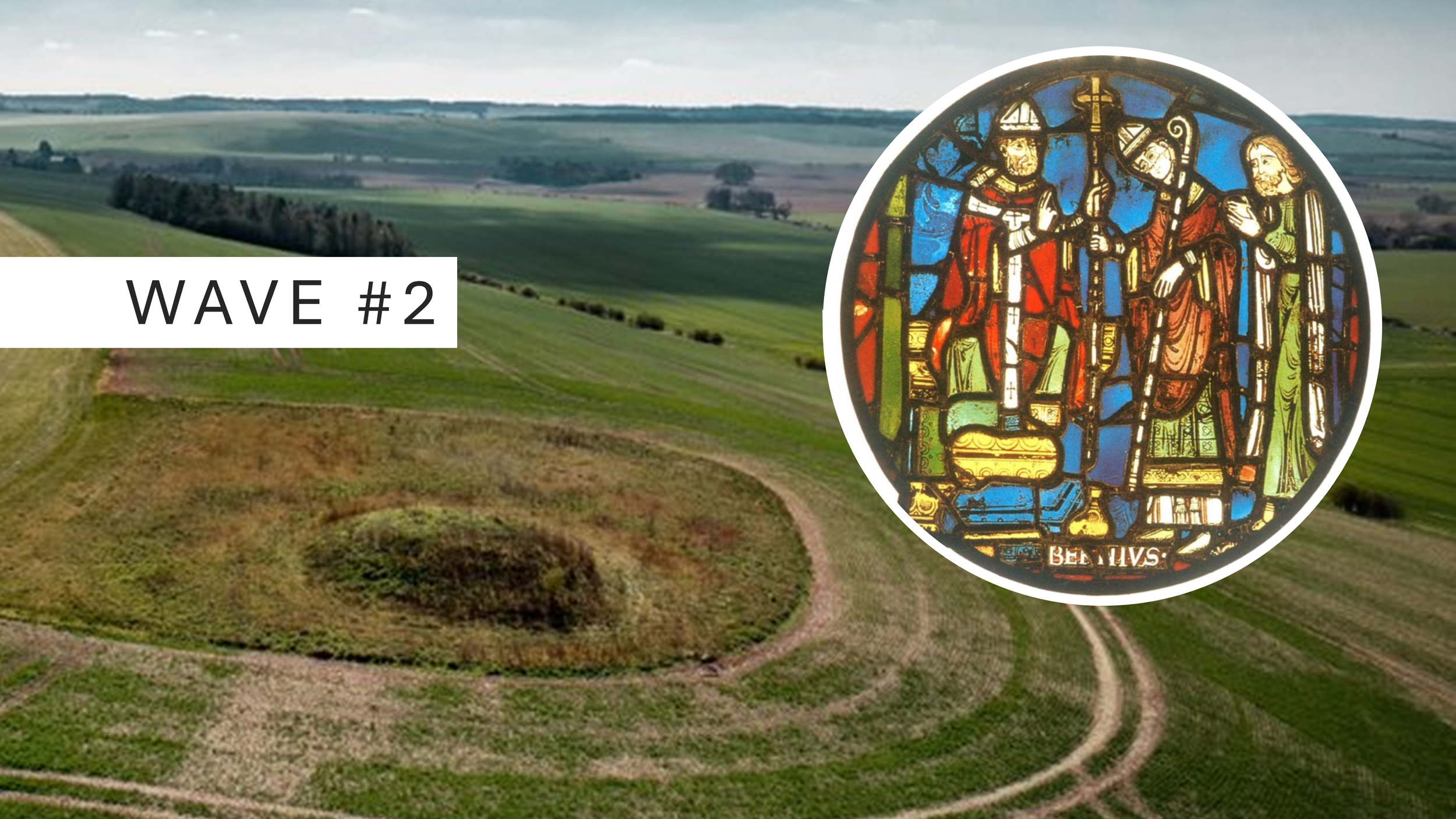
600-700 A.D.
In 595AD, Pope Gregory sent missionaries to evangelise the Saxon tribes of Britain. One by one, Saxon lords accepted Christ. Birinus preached to Cynegils, king of Wessex, at Churn Knob near Blewbury and he too was baptised. A wave of priories was founded across the region, including one begun c.700AD next to the confluence of the Thames and the Cherwell rivers, which would become the hub of a new city: Oxford. It thrived… until the whole city was burnt to the ground by Danes in 1002AD.

1000 A.D.
After the Norman conquest, Oxford enjoyed a period of stability and several churches were built. Crucially, some of them taking inspiration from the Abbey of Cluny, as part of the English Benedictine Revival. One key practice was the radical step of founding ‘collegiate churches’ (e.g. St George-in-the-Castle) meaning that they had not just one priest, but a group who worked together as a team! Learning flourished and young people began to gather in Oxford to be formed by these esteemed leaders, and these habits of Christian ‘college’ (which means ‘community’) and learning became the seedbed from which Oxford University grew as a nationally-significant spiritual hub, with the motto: Dominus illuminatio mea (The Lord is my Light).
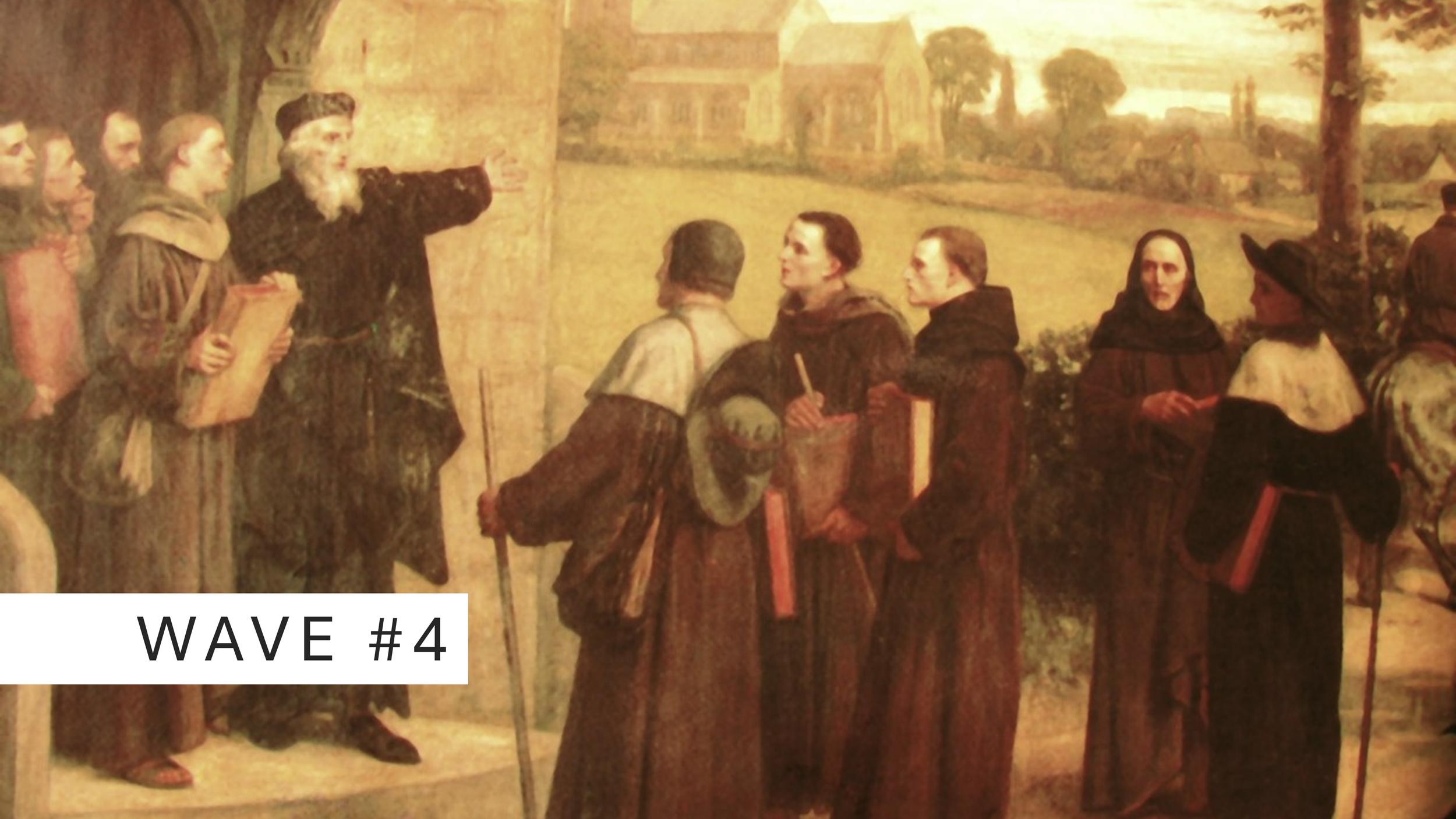
1300 A.D.
John Wyclif (1328-1384), professor of theology at Oxford University, challenged the low state to which spiritual life had once again fallen. He exposed abuses by church leaders, translated the Bible into English, and taught that everyone could relate directly to God. He also trained up preachers to travel throughout Britain telling people about Jesus… until he was exiled from the city and the movement he founded was fiercely persecuted by the bishops.
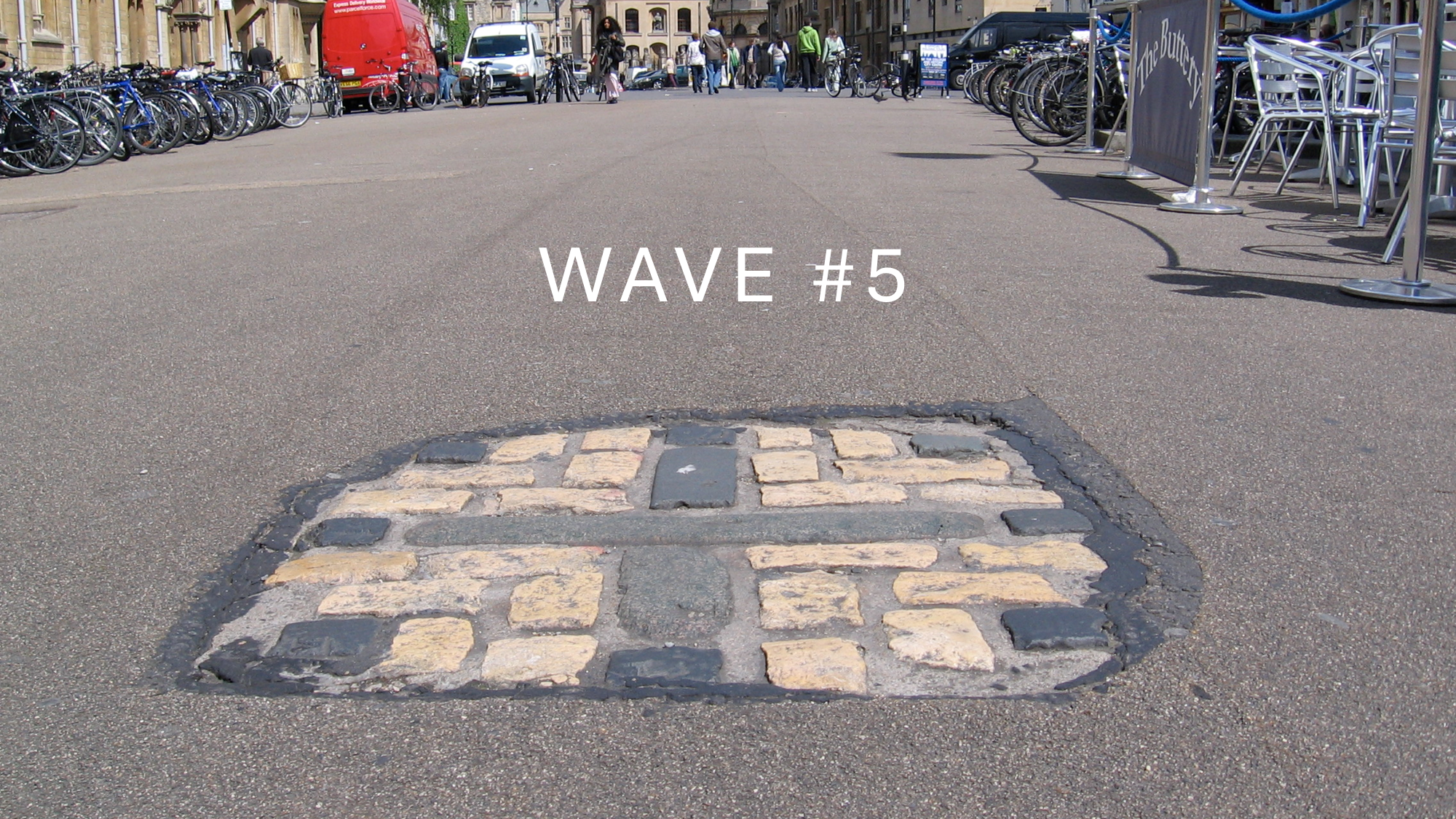
1500-1600 A.D.
Wiliam Tyndale (1494-1536) was a schoolboy in Oxford. He contributed massively to the wave of revival in religious feeling and belief that we call ‘the Reformation.’ Then, in 1555-56, Anglican bishops were burnt at the stake in Oxford’s Broad Street. Latimer cried out, “"Be of good cheer, Ridley; and play the man. We shall this day, by God's grace, light up such a candle in England, as I trust, will never be put out.” And that spiritual fire did burn… until it was gradually dimmed by a creeping rationalism, such that a later historian would say “From the year 1700, England seemed barren of all that is really good… Christianity seems to lie as one dead.”
1740-1850 A.D.
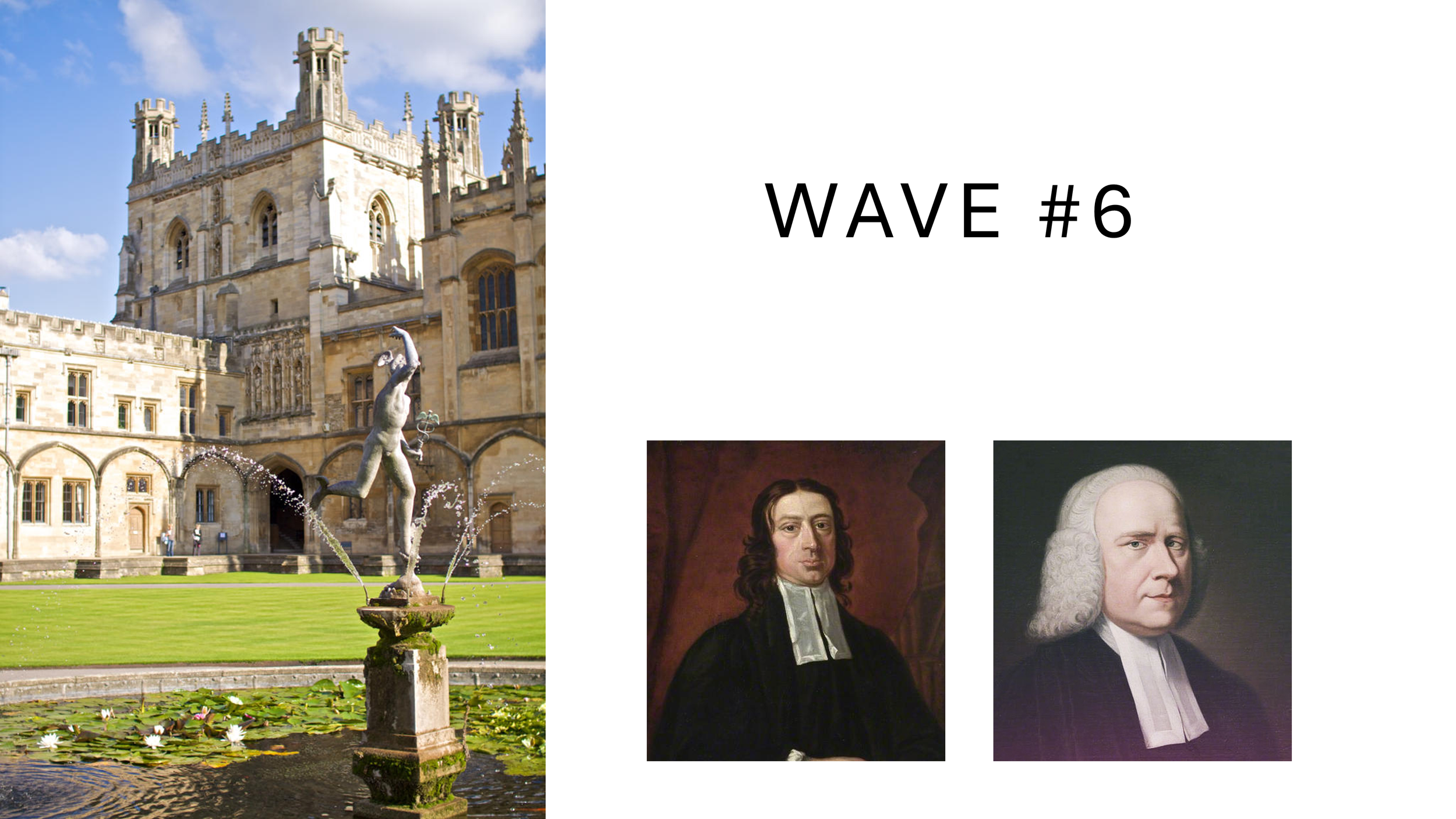
The Holy Club was begun in Christchurch (the site of the original Saxon priory) in 1729, and its members (most famously, John Wesley and George Whitfield) went on to preach the gospel, plant churches and inspire successive generations to “reform the nation.” When Wesley died in 1791, there were 72,000 Methodists in Britain and Ireland. By 1850, when church attendance peaked, there were 2.5million, and the nation was indeed changed… until growing secularism began to push Christian faith out of mainstream culture. One sociologist has even predicted the extinction of Methodism by 2045.
2000 A.D.
At the turn of the millenium, it was 250 years since Methodism had first took off. In 2024, I finished my talk by saying, “Religious revivals seem to have taken place here within every 300 years. It’s now 295 years since the Holy Club was founded. Should we not now expect another spirtual awakening?”
Right Now
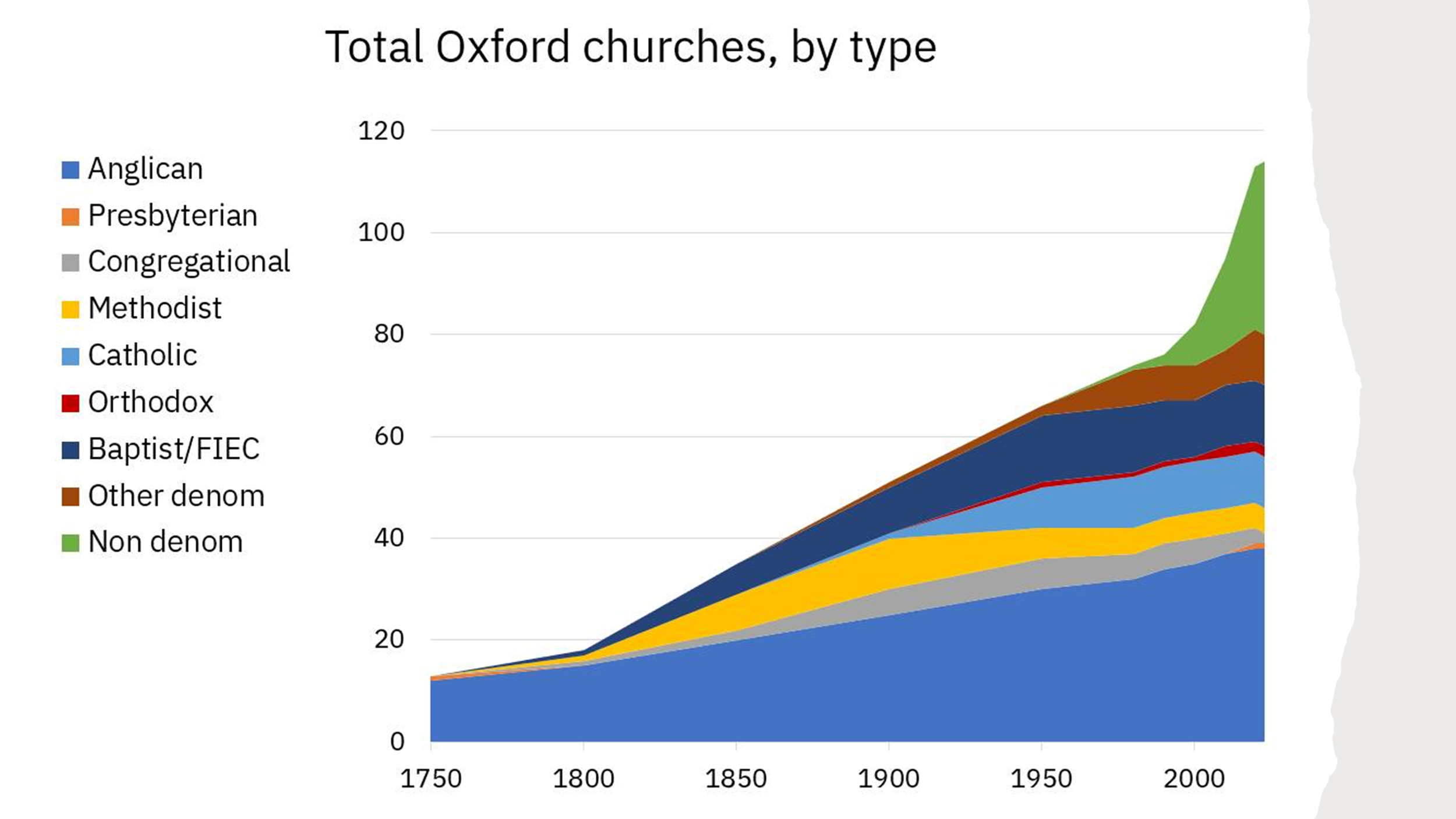
My final slide showed the number of churches in Oxford from 1750 to 2024. That number increased from 1750 to 1850 at a faster rate than the city population. Then, from 1850, while the number of churches continued to grow, it was at a much slower pace than the city as a whole. However, since the 1990s, there has been a striking shift. In last 30 years, a new church has been planted roughly every 6 months, which far out-strips population growth. So, in fact, a new wave has already begun, right under our noses!
Of course, as you’d expect from my previous blogpost (‘Questioning Confident Leaders’), this telling of history raises a heap of questions, including:
What about other religious movements outside of this pattern (e.g. 13C mendicant orders, 19C Oxford Movement)?
How does the number of new churches relate to the number of worshippers?
Why (on earth!) should religious feeling ebb and flow in three-century cycles?
Can we really expect a single wave of Christian revival to wash through a highly plural society, such as we have in Britain today?
I have a few thoughts about those questions. But, more importantly, I can report that the upturn in Oxford church life is continuing apace.
In 2025, Renew Oxford mapped the churches of the city and found that - including 35 college chapels - there are now 174 worshipping communities (aka churches) in the city. At least 60 of those are diaspora groups: Nigerian, Brazilian, Kenyan, Nepali, Romanian, Indian, Ghananian, Korean, Chinese, Filipino, Zimbabwean, East Timorese…
The UK church is often perceived to be old and white and declining, but none of that is true here. In Oxford, the Christian community is growing in number, astonishingly diverse and proving attractive to young people.
This news was kept surprisingly quiet for a long time (as also happened in Boston MA), but similar growth is now being reported across the nation, as Bible Society, Justin Brierly and others are helping to make known.
It seems to me that revival is coming, and right on time.