Questioning Confident Leaders
I sometimes get the privilege of speaking to groups of people starting out on a course of theological study. When I do, I’ve made it my habit to ask them each to find a blank piece of paper and a pen, and to imagine that sheet of paper represents all knowledge that exists. I then ask them to draw a circle representing the sum of all they know. After just a few seconds, most people wish they had a finer tip on their pen, so that they could draw a smaller circle.
We then talk about how extremely limited we all are, and how foolish it is to imagine any course of study will answer all our questions.
We might reflect on book of Job and the question of why he suffered so much. The book’s first chapter gives a very clear and simple understanding of why he suffered, but Job’s own encounter with God does not give him that answer. Instead, it gifts him a series of different questions.
Very often, people study theology in the hope of working through their list of questions and finishing the course with a much-reduced list of ‘loose ends.’ In fact, what usually happens is that the list of questions gets longer, which leads some students to despair and to ask whether anything can be known for sure.
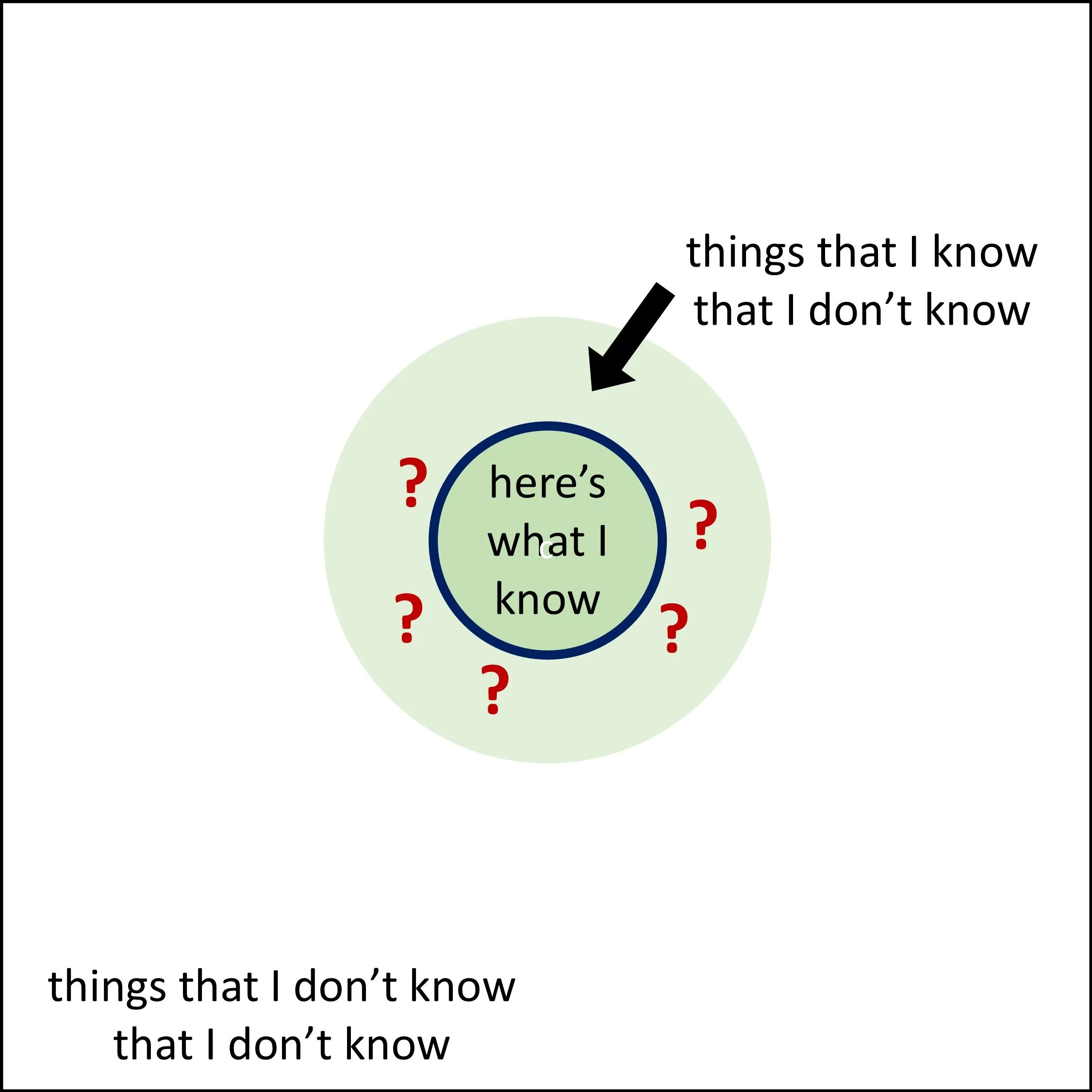
However, if we were to go back to that tiny circle drawn with a fine tip and to zoom right in, we would find there a kernel of things that can be known for sure. Amid the great ocean of potential knowledge, we each hold to some knowledge with a deep confidence, believing them to be facts. And, part of that knowledge is an awareness of facts that we know exist, but that you are not yet known to us (‘things that we know that we don’t know’). Then, beyond that lies the ocean of ‘things that we don’t know that we don’t know,’ that is, the answers to questions that we can’t even imagine asking.
Goodness, this sounds very philosophical! - but it gets to the heart of how we can confidently believe anything at all. The key insight is to recognise that my list of questions equates to a list of ‘things that I know I don’t know.’ A diagram may help make this clear…

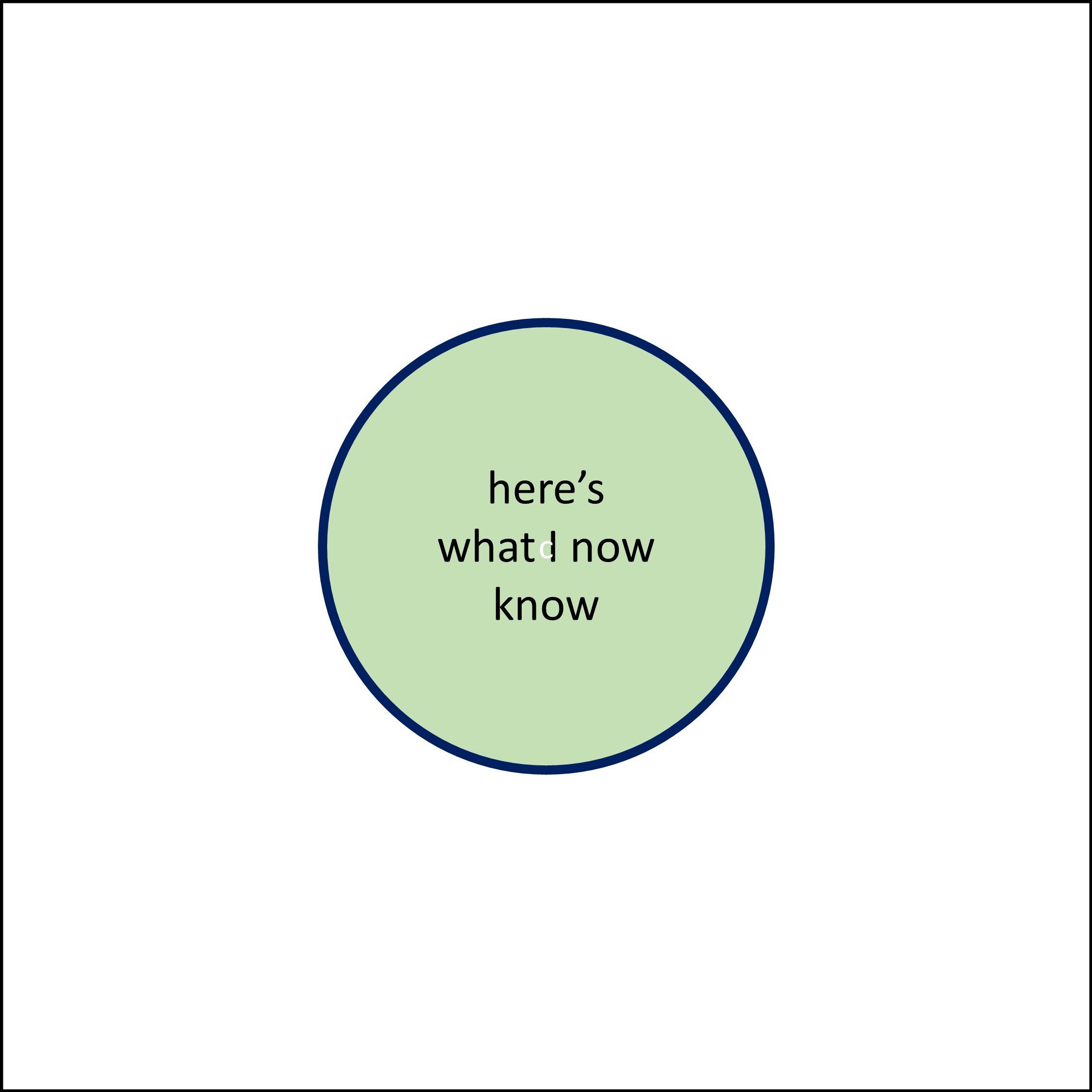
Then, whenever a question is answered well, of course it increases the cirle of our knowledge. In that moment, a question gets ticked off the list, and we enjoy being better informed.
However, as the sum total of our knowledge grows, we naturally see a growth in our awareness of the things that we don’t yet know about. In other words, when we receive information that we feel we can trust, we actually gain more questions. “Every answer begets a whole new family of questions.” If curiosity leads us to pursue the new questions, we will have both answers and questions increasing in number throughout our lives.
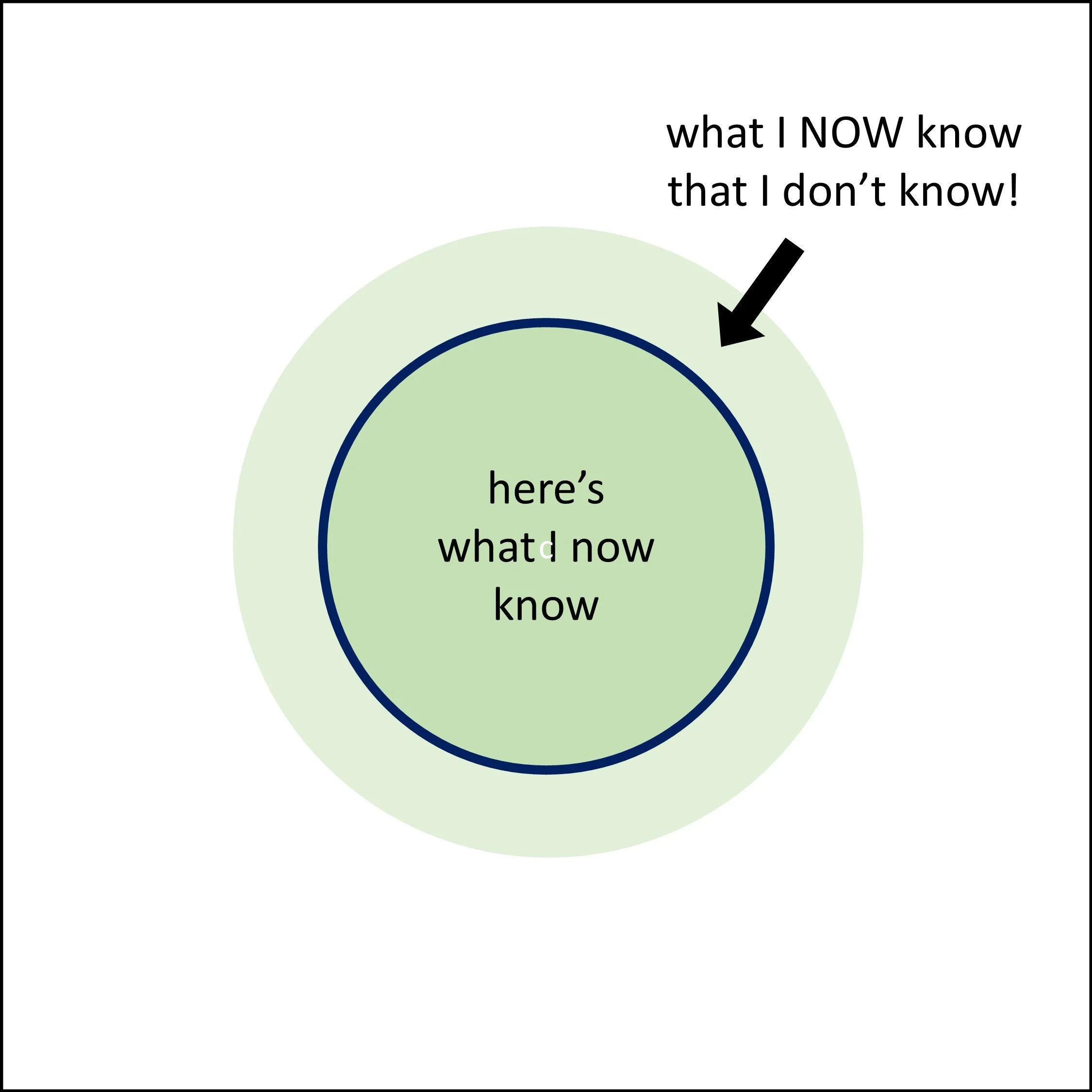
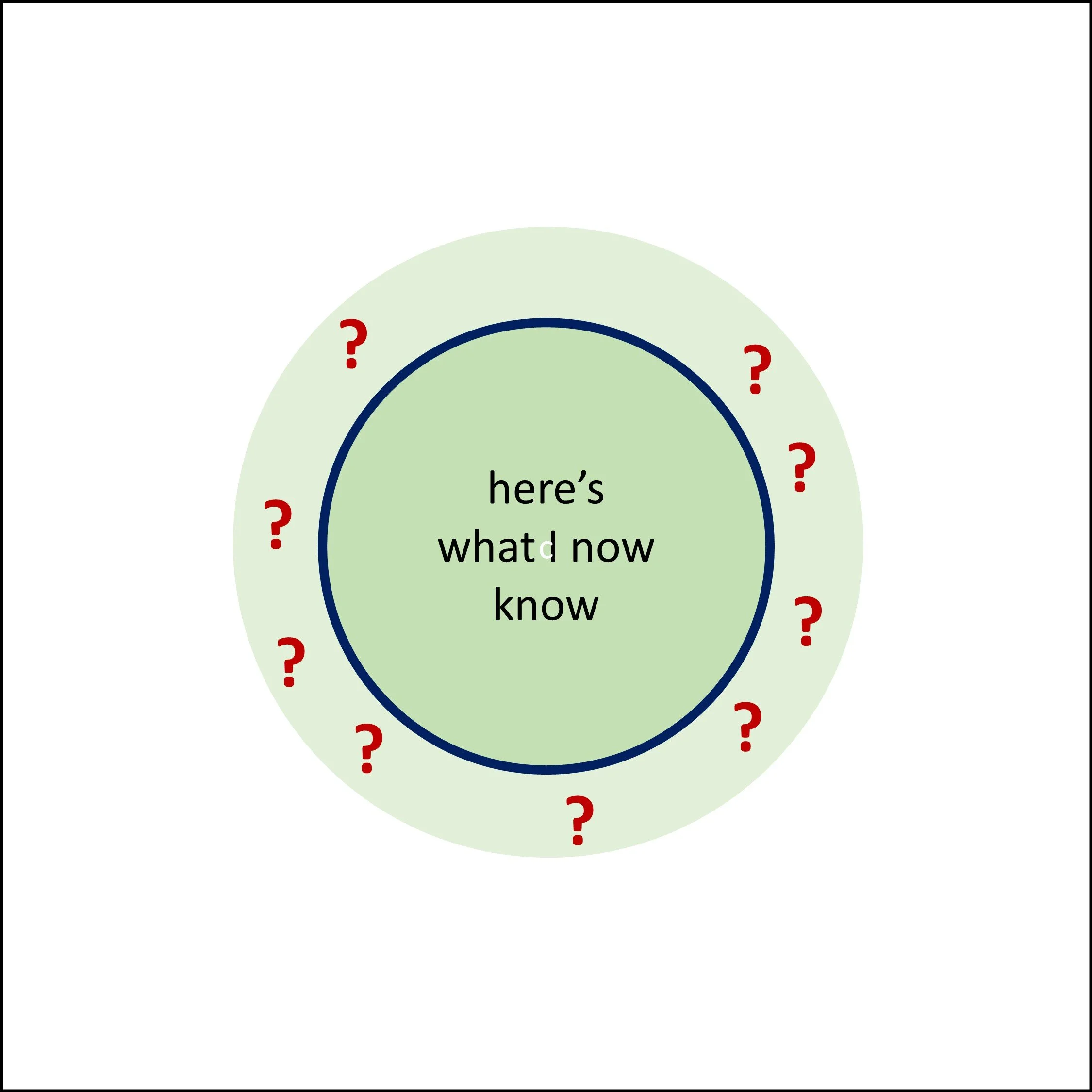
This is why any course of study, assuming that it encourages you really to think, will gift you with both knowledge and a longer list of questions. So, the goal is not to whittle down the list of big questions to a minimum, but rather (a) to see a gradual improvement in the quality of questions being asked, and (b) to learn to be at peace with the limits of our knowledge, while still remaining confident of what knowledge we have.
Some people - whether through personality or upbringing - enjoy having definite knowledge and are discomfited by unanswered questions. Other people - for whatever reason - feel very much at home with mystery, and tend to look down on anyone who likes their facts to be nice and clear. That is, some people seem to prefer answers and others to prefer questions, but we all learn through cycles of questioning and gaining answers and asking more questions. (These differences may be related to what Ian McGilchrist has explained about the left and right hemispheres of the brain, in which case I’m saying that we do well to use the whole of our brains!)
In leadership, those different preferences lead either to a dogmatic/directive style (i.e. telling people what it’s right to believe and to do, not allowing the leader to be questioned) or to a rather vague approach (i.e. telling people what we currently believe, and not attempting to persuade anyone to follow us). Neither kind of leader will get very far in raising up a movement (or even a team!) to make a positive difference in the world. For that, we need leaders who are humble and who hold strong convictions. We need leaders who are both questioning and confident, who can wholeheartedly sing “I cannot tell… but this I know.”
One further thought: Since God designed this whole process of human learning, we might ask about his purpose in making it this way. It is clearly not designed to maximise our confidence in what we know, and this reveals a deeper purpose, which looks beyond knowledge to the higher virtues of a loving relationship. The Bible tells is that God is the true source of all love, joy and peace. He knew that, endowed with any kind of ability to learn, humanity would be tempted to pursue knowledge as the route to peace and joy, and so be distracted from walking with him and thus disconnected from the very goodness that we seek. It seems to me that he designed this pattern for human learning, in which the questions keep increasing, to provide us with a constant reminder of the limits our knowledge and to steer us away from an addiction to knowledge as the source of security and joy, that we might instead seek his company. Then, once united with him in love, we discover a relational mode of learning with him. As Paul prayed for the believers in Colossae, might we then “know the mystery of God, namely, Christ, in whom are hidden all the treasures of wisdom and knowledge” (Colossians 2:2-3).