Over the last few years, along with Neil Townsend, I’ve taught a 7-week course for a Californian megachurch. In a couple of visits there, we were deeply touched by the rare degree of their whole-hearted love for God and for people. Then, one of their course leaders said to us, “We know that our heart and passion are strong, but we’re not so good at the thinking part. Could you Oxford guys, with your PhDs, teach our students to think better?” And that’s how we ended up teaching a module titled, ‘Loving God With All Your Mind.’
Spiritual Types
We start the course by introducing the students to a framework describing different ‘spiritual types,’ which places value on the role of both heart and mind.
Back in 1980, Urban Holmes III published a wide-ranging survey from church history of types of Christian spirituality. He summarised them all in a framework that he called a ‘Circle of Sensibility,’ with two defined axes.
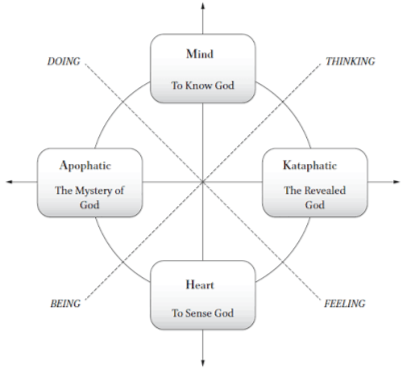
This analysis has been picked up many times over subsequent years, which rather proves its value, including by:
Corrine Ware, Discover Your Spiritual Type, 1995
Kenneth Boa, Conformed to His Image, 2001
Samuel Baker, Raised a Teenage Kataphatic, 2015
However, there are a few issues with this framework. Firstly, some of the language is rather opaque and thus off-putting. Secondly, whatever reasons Holmes had for focusing on personal experience of God, it tends to encourage people to think about spirituality in terms of themselves. Thirdly, people tend to approach it as a personality test, asking ‘What type am I?’
Our approach
We wanted to overcome those issues, with a framework that communicates more clearly, moves students to think about how they are loving others, and stretches students into area of spirituality beyond their current range.
So, drawing on Mark 12:30 (“Love the Lord your God with all your heart and with all your soul and with all your mind and with all your strength”), we produced an amended version:
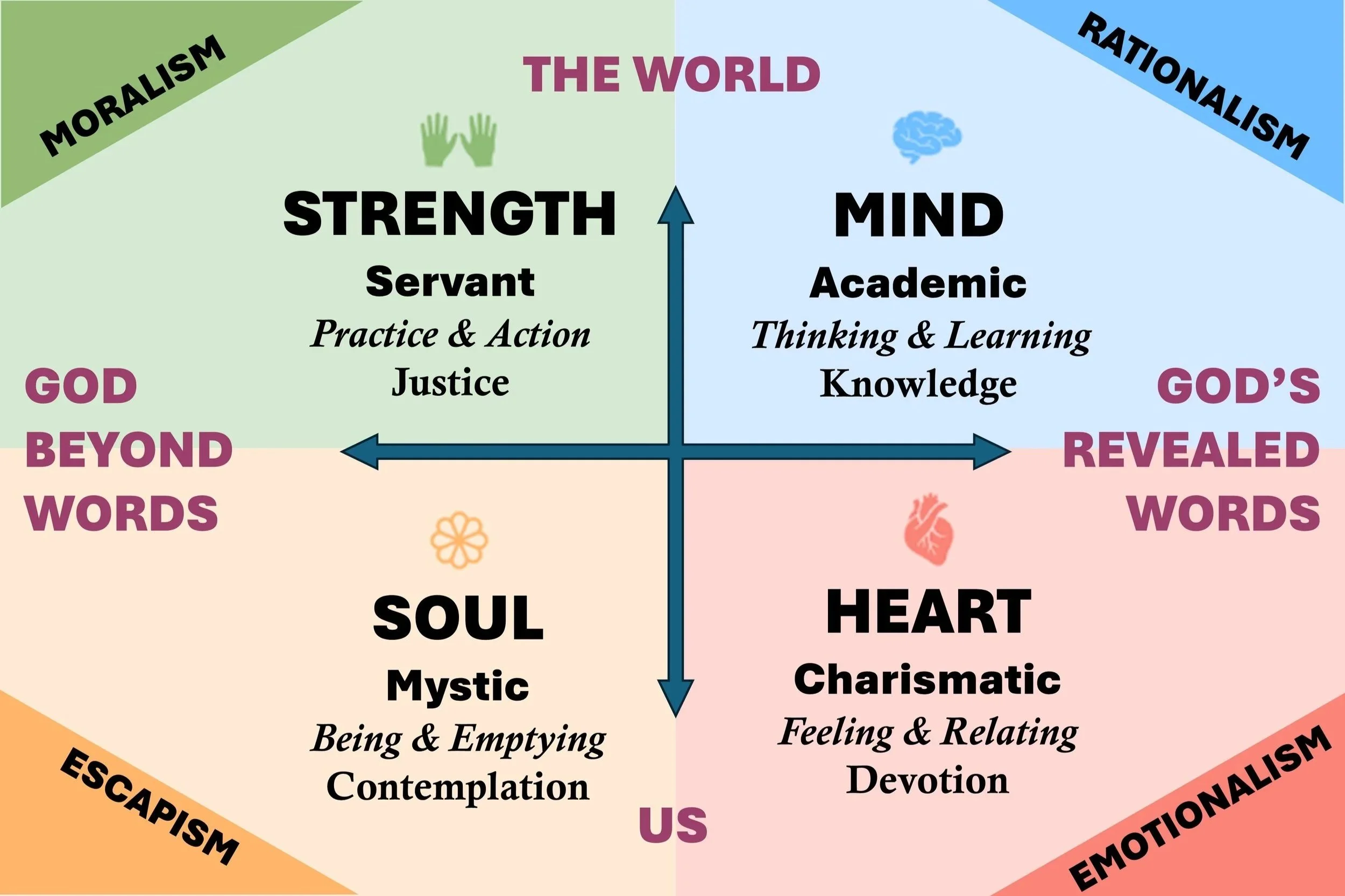
As we look at this, we prompt students to ask:
Which is/are your natural type(s) of spirituality?
What extremes do you therefore risk drifting into?
What aspect of love is God leading you to nurture in this season?
Do you participate in a church that matches your own nature, or one that challenges you beyond it?
A More Ancient Way
This makes for a good introduction to our module, and it also provides a launchpad to step beyond our current historical moment and to explore a more ancient path. Our modern understanding of human nature, the brain and the mind is very different to people 100 years ago, let alone Bible times which go back to the Bronze Age.
Mark 12:30 (along with Matthew 22:37 and Luke 10:27) is a translation into Greek of Jesus’ spoken words in Aramaic, in which he was quoting Deuteronomy 6:5, which was written in Hebrew.
“Love the LORD your God with all your lev and with all your nephesh and with all your mōd.”
Each of those Hebrew words in italics carried a rich meaning that was not easily translated into Greek. (In fact, the ancient Greek translation, the Septuagint, doesn’t even try to translate mōd!)
As Lyndon Jost noted in his recent book Transfiguring Headship, the ancient Hebrews associated different parts of the body with all sorts of aspects of human experience. They said that they felt joy in the liver, discomfort in the kidneys and compassion in the bowels. A reference to ‘the hands’ spoke of power and ability, while someone’s length of patience was discussed as them having a short or a long nose. They had no abstract way of speaking about someone’s presence, but spoke about being “with faces.” To have a foreskin was to be an insensitive person, and bodily fat symbolised unreceptiveness.¹
What Love Looks Like
Here, then, is quick rundown of what those Hebrew words in Deuteronomy 6 actually meant:
Lev: literally means ‘heart,’ which we now think of as both an organ for pumping blood and the seat of emotions, but for the ancient Hebrews the heart was the place of thinking. See, for example, Proverbs 23:7 ("as he thinks in his heart”) and Genesis 6:5 ("The Lord saw … every intention of the thoughts of his heart”). In contrast, ancient Greek used diverse words to refer specifically to the mind and thinking, and so we find Mark and Luke using two Greek words - kardia (‘heart’) and dianoia (‘mind’) - to convey the richness of the Hebrew ‘heart that thinks.’
Nephesh: translated into Greek as psyche, and into English as ‘soul.’ Today, being familiar with the study of psychology, we might think of this as something like our ‘inner being.’ However, there is an older English use of the word ‘soul’ that gets closer to the Hebrew nephesh, as in the statement that “fifty souls were lost at sea,” where ‘soul’ signifies the whole of a person. To love with all your nephesh is to love with the totality of all that you are.
Mōd: means ‘utterness’ or ‘muchness.’ To love with all your mōd is to give it everything you’ve got, to love with all that you have. This is what the Septuagint failed to translate, and for which the gospels use the Greek word, ischous, meaning ‘strength.’
This ancient vocabulary for love is beautifully echoed in the modern Anglican wedding liturgy, which I guess was written by people who knew the Hebrew language.
With my body I honour you, all that I am I give to you, and all that I have I share with you, within the love of God, Father, Son and Holy Spirit.
This is the kind of love that we are all called to nurture towards our Maker. Whatever aspect of love you feel most inspired to nurture in this season (heart, mind, soul or strength), God invites us for all our days to keep moving to fuller expressions of love until, one glorious day, we hold nothing back. And so, we sing, as a statement of intent and to look forward to a promised future: All to Jesus I surrender, all to Him I freely give.
(1) Jost, L. (2026), Transfiguring Headship, pp.50-51. That list leaves open the question of quite what the head is used for. Jost also recounts (p.34) how some ancient Greeks believed that the head was opposed to reason and hard to control, while others believed it was where sperm came from. The Celts viewed the head as a container of a sacred force. Jost argues that the Hebrews saw the head primarily as the one part of the body that represented the whole person.