It’s not often that a chart changes your whole perspective on the role of the church in the world, but that’s what happened for me when Viv Grigg, a professor of Urban Leadership, shared with me the following illustration from his (unpublished) teaching materials.
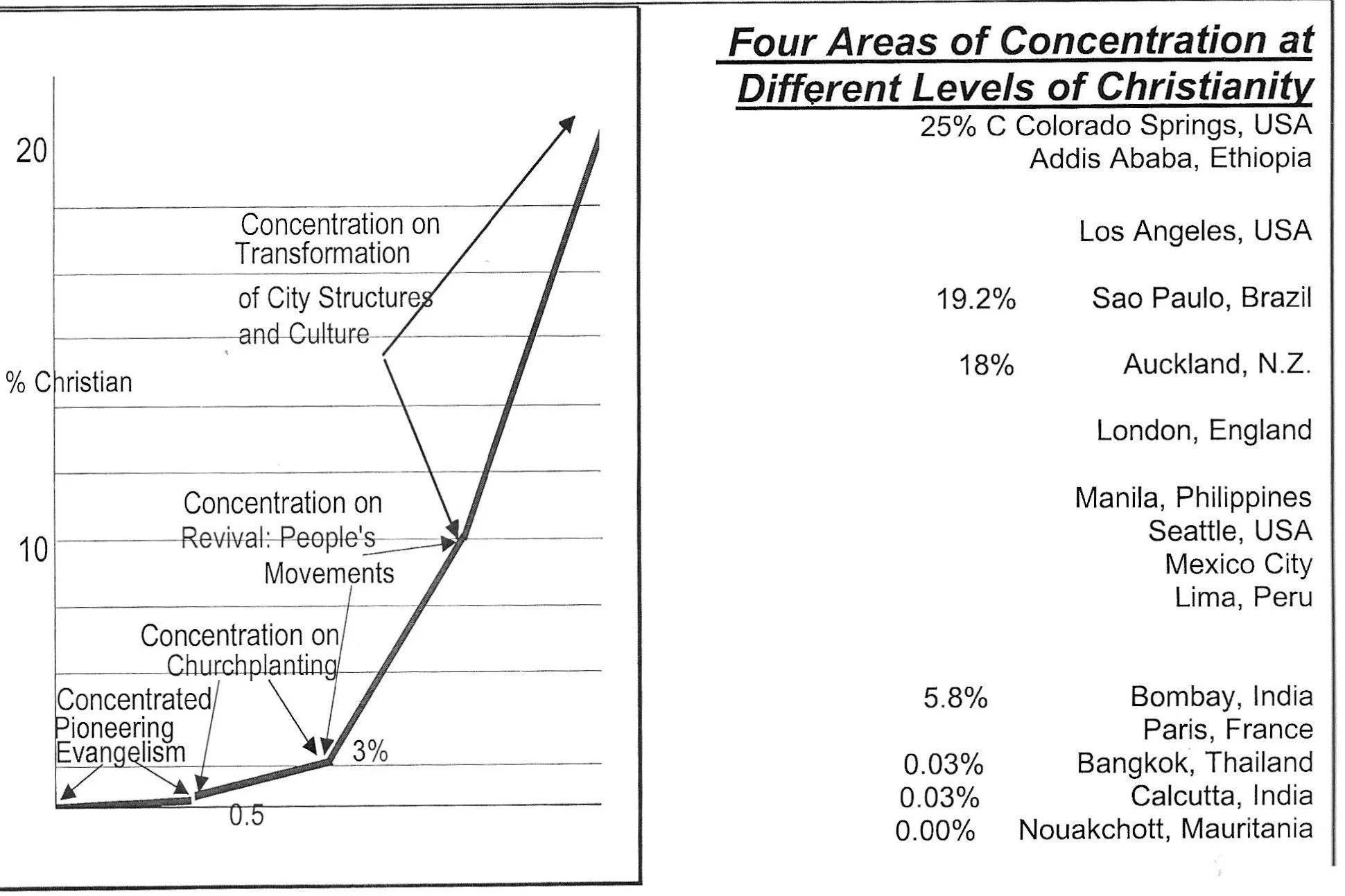
The chart is meant to illustrate how the church may grow over time in a place, and how that leads to new ministry opportunities for the benefit of people and the transformation of a place. Of course, the percentages given on the right have changed in the years since this chart was printed, but seeing those four stages was a seminal moment for me, and I want to spend a few minutes unpacking what they mean and how they can relate to each other.
The Stages of Growth
When the population of a city has never heard the good news about Jesus, when there are no church communities and no one knows or values Jesus’ teaching, Christian influence could only ever be achieved through coercion, which is not the way of Christ. So, both for the sake of individuals and out of concern for that society, the only viable Christian ministry in such places is to share the good news of Jesus with local people (i.e. ‘pioneering evangelism,’ which is to say, ‘speaking about Jesus, naturally accompanied by loving care for neighbours’). This is the situation today in many cities around the world, which are mostly to be found in countries where government places heavy restrictions on religious freedom.
Once some local residents start to believe the good news about Jesus, whether through meeting Christians in person or media ministries or supernatural encounters, it becomes possible for them to gather as local churches. Possible, but not always easy. Many cultures lack any heritage of forming such fellowships and, where religious freedom is limited by law, there will also be fear that any church member who backslides could report the others to the authorities. Still, followers of Jesus, guided by the Bible and the Holy Spirit, will want to gather together, and churches will form even in very hostile environments. In other words, the initial focus on pioneering evangelism is now accompanied by church planting.
Then, when there are multiple local churches, questions inevitably arise about how they relate together and how they might strengthen each other, leading to the formation of networks that provide support and accountability, as well as training leaders. Such networks have the power to turbocharge the spread of the gospel, which is why Viv chose to call them ‘Revival: People Movements.’
Once the Christian population grows to, say, 10% of the local population, there will be believers in a wide range of positions in that society, and many opportunities to catalyse change in the social structures and culture, through starting new organisations (e.g. charities) and institutions (e.g. schools), by political campaigning, through professional networks, through the arts and media, etc.
Each Stage can Strengthen the Others
The line in Viv’s chart ticks upwards at the start of each new stage, indicating that the development of each stage makes the gospel ever more attractive to local people, and so accelerates the pace at which more people are ready to follow Jesus. That is:
the formation of local churches can aid pioneering evangelism
the formation of church networks can strengthen both local churches and their witness
the development of initiatives for social/cultural transformation can upgrade church networks, their congregations and their witness
A local church can strengthen its members’ gospel witness through training, prayer, mutual encouragement and shared activities. A church can also make it much easier for people to take the radical step of following Jesus, by providing a warm and supportive community for them to join.
A church network can strengthen its local churches in a great many ways, including a shared hardship fund, the dissemination of best practice and the circulation of gifted ministers who can equip people for diverse ministries. A network can also strategize and catalyse the formation of church planting teams, and so pick up the pace at which new churches are formed.
Initiatives for social and cultural transformation can be a fountain of goodness that cascades benefits into every expression of Christian mission.
To evangelism: making the gospel more meaningful, as people benefit from being shown the practical significance of the gospel for their everyday life
To local churches: helping churches to find local partners with shared dreams, bringing extra resources and opportunities for connection/influence
To networks: helping them to innovate and to have more audacious imagination, a stronger sense of purpose, and constructive engagement with other church networks and with civic leaders, businesses, universities, etc.
These Stages are not Automatic Developments
Despite these many benefits, it is not a given that the later stages will develop. I have met some Christians who dedicate themselves to evangelism and win people to Christ, and who then meet with those new believers one-to-one, without ever introducing them to other believers. This is perhaps most common in those countries that persecute churches, where there is fear that any backsliders would betray a whole fellowship, but sometimes it’s just because planting and building a church is seen to be hard work! Church leadership requires knowledge and skills beyond the regular tools of an evangelist, and so it requires either the existing leaders to learn a lot of new stuff or for people with different gifts to be accepted as the new leaders. In either case, if evangelism is to be accompanied by church planting, it requires an active choice to pursue something new, and determination to push through the inevitable challenges of change.
I have also met church leaders who believe that every local church should be a self-sufficient body, reliant on Christ alone, complete in its range of ministry, and therefore not needing to partner with a network. Whenever I hear that being said, it takes me back to another seminal moment in my life, which happened during a conversation over dinner in an Italian restaurant.
I was working with a team to write a bid to the UK government for funding for a new school in Oxford. We sought out advice and support from educational experts, and there was one such expert living in Oxford, whom we really wanted to meet. Before retiring, Sir Tim Brighouse had been the officer overseeing all of London’s schools, and they had improved markedly on his watch. He agreed to meet us for lunch and, between courses, he said, “The way I see it, your new school is doomed to success for about 15 years, as long as the founders are involved. What I want to know is: what are you doing to ensure that it will still be a success in 25 years’ time?”
At the time, we were totally unprepared to answer such a long-sighted question, and Sir Tim declined to lend us his support. Since then, we have learnt that every school has its ups and downs, and therefore needs to be part of something larger. For most UK schools, this means being in a multi-academy trust, which can provide objective monitoring of the school’s performance and intervene to ensure ongoing health. (Happily, our bid was approved and the school that we founded is part of an excellent multi-academy trust. We’re only 12 years in, but it’s clear that we’re now set-up to thrive for 25 years and beyond.)
Like schools, congregations can benefit greatly from a network. Church networks can actively connect congregations to centres of spiritual renewal and call them up into more strategic action. Ideally, those networks will also have capacity to monitor and to intervene as needed.
However, those network activities can be rather demanding, especially for the network leaders, who often need to spend time away from home and find themselves grappling fairly constantly with the most gnarly challenges arising anywhere in their network: a pressure which Paul ranked right alongside imprisonment, beating and shipwreck (2 Cor 11:28). When a local church leader accepts a call to network leadership, they quickly discover that it requires a serious upgrade in their leadership skill and capacity, as it demands much clearer statements of vision and values, longer-term thinking, the ability to work with diverse strong personalities and then to sleep well despite everything that goes on!
For those reasons, together with the tendency of many congregations towards parochialism, local churches do not automatically form meaningful networks. It requires an active choice to do so, and determination to push through the inevitable frictions.
Once networks of churches are formed, they do not automatically engage with initiatives to influence their society’s structures and culture. Just as local churches tend to be led by people who are happy to spend all their time in and around their flock, so church networks tend to be led by people who are happy to spend their days in visiting local churches and meeting with other church leaders. Plus, societal influence demands yet more leadership skills. It requires learning about other sectors of society, their aspirations and challenges. It is also quite challenging to relate well to organisations that hold some contrary views to your own, while also overseeing doctrinal fidelity in your own network. Effective Christian leadership always requires a combination of confidence and humility, but that gets harder each time your sphere of influence expands.
Each stage of the growth of Christianity in a place requires radical decisions and much new learning, whether from pioneer missionaries who move continents and learn new languages, or from public Christian leaders who embrace audacious dreams of a better world and who soldier on through frequent headwinds of misunderstanding. Yet, each of these developments is worth the price we pay, as we press on towards the prize of everyone hearing about Jesus, whose life, death and very existence are tremendously good news.
Some Risks and A Prayer
I’ve just been very clearly positive about Christians and churches going ‘up through the gears’ by layering up these four stages of ministry. However, there is also a clear danger here, namely that each new stage of development might in fact detract from the others.
Very often, when a season of pioneering evangelism leads to the formation of a new local church, that community of believers sees a decline in its evangelistic activity, as mission-minded leaders are replaced by more pastorally-motivated individuals, or the community is increasingly absorbed in its own administration.
Similarly, once a network is established, it can easily become self-absorbed. There may be so many joint-church meetings in the diary that each local church gets distracted from its local mission. Pastors may spend long hours in discussions seeking to reconcile local differences into a common policy, and network leaders can become absorbed with supporting the least healthy congregations. For younger leaders, an aspiration for a network leadership role may distract them from the call to pioneer a new congregation, and it is rare to find a church network leader (or bishop, superintendent minister, etc.) who sustains a lifestyle of personal evangelism. It takes serious intent for a network to remain mission-oriented and to keep planting new churches.
Then, if a network of churches engages with the call to social and cultural transformation, it may well find those challenges to be preoccupying and get wholly absorbed in social action or in politics, to the neglect of everything else.
It takes serious intent and divine help to hold all four stages together fruitfully. Indeed, it may be too much for anyone to keep in mind all these levels of concern.
I once heard Sir David Bell say, from his long experience in leading large organisations, that some people instinctively engage with a forest at the level of leaves and twigs, while others think about branches or whole trees, and then some consider the whole ecosystem. His point was that these lenses are all valid and important, and a large organisation needs ‘leaf people’ (who cover the details), ‘landscape people’ (who oversee the whole) and ‘tree people’ to hold it all together. I would add that we want all people to be celebrated for what they bring, and we want to ask everyone please to understand the limits of their perspective and to celebrate people who think differently.
So, my prayer is not that every believer engages equally in each of the four stages that Viv Grigg described, but that we might somehow cover them all between us, all the while celebrating people whose ministry is focused on a different level to our own.